Tool-Using AI Agents: Web Search, Code Execution & API Integration
Build powerful AI agents with real-world tools. Learn to integrate web search, execute code safely, work with files, and connect to external APIs using LangGraph.
Moshiour Rahman
Advertisement
AI Agents Mastery Series
This is Part 4 of our comprehensive AI Agents series.
| Part | Topic | Level |
|---|---|---|
| 1 | Fundamentals - Build from Scratch | Beginner |
| 2 | LangGraph Deep Dive | Intermediate |
| 3 | Local LLMs with Ollama | Intermediate |
| 4 | Tool-Using Agents | Intermediate |
| 5 | Multi-Agent Systems | Advanced |
| 6 | Production Deployment | Advanced |
Tools Transform Agents
Without tools, agents are just chatbots. With tools, they become autonomous workers:
| Without Tools | With Tools |
|---|---|
| ”I can’t access the internet” | Searches web, retrieves data |
| ”I can’t run code” | Executes Python, returns results |
| ”I don’t know current prices” | Calls APIs, gets real-time data |
| ”I can’t modify files” | Reads, writes, transforms files |
This tutorial covers building production-quality tools for your agents.
Setup
pip install langgraph langchain-openai langchain-community \
    tavily-python requests beautifulsoup4 python-dotenv
# .env
OPENAI_API_KEY=your-key
TAVILY_API_KEY=your-tavily-key # Free tier availableTool Categories
| Category | Examples | Use Cases |
|---|---|---|
| Information | Web search, Wikipedia, news | Research, fact-checking |
| Computation | Python REPL, calculator, SQL | Data analysis, calculations |
| External APIs | Weather, stocks, databases | Real-time data |
| File Operations | Read, write, convert | Document processing |
| System | Shell commands, processes | Automation |
Building Custom Tools
The @tool Decorator
LangChain’s @tool decorator converts functions into agent-compatible tools:
# custom_tools.py
from langchain_core.tools import tool
from typing import Optional

@tool
def multiply(a: float, b: float) -> float:
    """Multiply two numbers together.

    Args:
        a: First number
        b: Second number

    Returns:
        Product of a and b
    """
    return a * b

@tool
def get_word_count(text: str) -> int:
    """Count the number of words in a text.

    Args:
        text: The text to count words in

    Returns:
        Number of words
    """
    return len(text.split())
The docstring is critical—it tells the LLM when and how to use the tool.
Tool Best Practices
| Do | Don’t |
|---|---|
| Clear, specific docstrings | Vague descriptions |
| Type hints on all params | Missing types |
| Handle errors gracefully | Let exceptions crash |
| Return structured data | Return ambiguous strings |
| Single responsibility | Multi-purpose tools |
Web Search Tools
Tavily Search (Recommended)
Tavily is built for AI agents—returns clean, structured results:
# web_search_tools.py
import os
from langchain_core.tools import tool
from tavily import TavilyClient
from dotenv import load_dotenv

load_dotenv()

tavily = TavilyClient(api_key=os.getenv("TAVILY_API_KEY"))

@tool
def search_web(query: str, max_results: int = 5) -> str:
    """Search the web for current information.

    Args:
        query: The search query
        max_results: Maximum number of results (default 5)

    Returns:
        Search results with titles, URLs, and snippets
    """
    try:
        response = tavily.search(
            query=query,
            max_results=max_results,
            search_depth="advanced"
        )

        results = []
        for r in response.get("results", []):
            results.append(f"Title: {r['title']}\nURL: {r['url']}\nSnippet: {r['content'][:200]}\n")

        return "\n---\n".join(results) if results else "No results found"

    except Exception as e:
        return f"Search error: {str(e)}"

@tool
def search_news(query: str) -> str:
    """Search for recent news articles on a topic.

    Args:
        query: The news topic to search for

    Returns:
        Recent news articles with headlines and summaries
    """
    try:
        response = tavily.search(
            query=query,
            max_results=5,
            topic="news"
        )

        articles = []
        for r in response.get("results", []):
            articles.append(f"📰 {r['title']}\n{r['content'][:150]}...\nSource: {r['url']}")

        return "\n\n".join(articles) if articles else "No news found"

    except Exception as e:
        return f"News search error: {str(e)}"
DuckDuckGo Search (Free, No API Key)
# ddg_search.py
from langchain_core.tools import tool
from langchain_community.tools import DuckDuckGoSearchRun

ddg_search = DuckDuckGoSearchRun()

@tool
def search_duckduckgo(query: str) -> str:
    """Search DuckDuckGo for information. Free, no API key needed.

    Args:
        query: Search query

    Returns:
        Search results
    """
    try:
        return ddg_search.run(query)
    except Exception as e:
        return f"Search error: {str(e)}"
Code Execution Tools
Safe Python REPL
# code_execution_tools.py
import subprocess
import tempfile
import os
from langchain_core.tools import tool

@tool
def execute_python(code: str, timeout: int = 30) -> str:
    """Execute Python code and return the output.

    Args:
        code: Python code to execute
        timeout: Maximum execution time in seconds (default 30)

    Returns:
        stdout output or error message
    """
    # Security: Basic validation
    dangerous_patterns = ['os.system', 'subprocess', 'eval(', 'exec(', '__import__', 'open(']
    code_lower = code.lower()

    for pattern in dangerous_patterns:
        if pattern in code_lower:
            return f"Security Error: '{pattern}' is not allowed"

    try:
        # Write code to temp file
        with tempfile.NamedTemporaryFile(mode='w', suffix='.py', delete=False) as f:
            f.write(code)
            temp_file = f.name

        # Execute with timeout
        result = subprocess.run(
            ['python', temp_file],
            capture_output=True,
            text=True,
            timeout=timeout,
            cwd=tempfile.gettempdir()
        )

        # Clean up
        os.unlink(temp_file)

        if result.returncode == 0:
            output = result.stdout.strip()
            return output if output else "Code executed successfully (no output)"
        else:
            return f"Error:\n{result.stderr}"

    except subprocess.TimeoutExpired:
        return f"Timeout: Code execution exceeded {timeout} seconds"
    except Exception as e:
        return f"Execution error: {str(e)}"

@tool
def execute_shell(command: str) -> str:
    """Execute a shell command (limited to safe commands).

    Args:
        command: Shell command to execute

    Returns:
        Command output or error
    """
    # Whitelist of safe commands
    safe_commands = ['ls', 'pwd', 'date', 'whoami', 'cat', 'head', 'tail', 'wc', 'echo']

    cmd_parts = command.split()
    if not cmd_parts:
        return "No command provided"

    base_cmd = cmd_parts[0]

    if base_cmd not in safe_commands:
        return f"Security Error: '{base_cmd}' is not in the allowed commands list"

    try:
        result = subprocess.run(
            command,
            shell=True,
            capture_output=True,
            text=True,
            timeout=10
        )

        if result.returncode == 0:
            return result.stdout.strip() or "Command executed (no output)"
        return f"Error: {result.stderr}"

    except subprocess.TimeoutExpired:
        return "Command timed out"
    except Exception as e:
        return f"Error: {str(e)}"
Data Analysis Tool
# data_analysis_tools.py
from langchain_core.tools import tool
import json

@tool
def analyze_data(data: str, analysis_type: str = "summary") -> str:
    """Analyze data and return statistics.

    Args:
        data: JSON string of data (list of numbers or objects)
        analysis_type: Type of analysis - 'summary', 'describe', or 'aggregate'

    Returns:
        Analysis results
    """
    try:
        import statistics

        parsed = json.loads(data)

        if isinstance(parsed, list) and all(isinstance(x, (int, float)) for x in parsed):
            # Numeric list
            numbers = parsed
            return json.dumps({
                "count": len(numbers),
                "sum": sum(numbers),
                "mean": statistics.mean(numbers),
                "median": statistics.median(numbers),
                "min": min(numbers),
                "max": max(numbers),
                "stdev": statistics.stdev(numbers) if len(numbers) > 1 else 0
            }, indent=2)

        elif isinstance(parsed, list) and all(isinstance(x, dict) for x in parsed):
            # List of objects
            return json.dumps({
                "count": len(parsed),
                "keys": list(parsed[0].keys()) if parsed else [],
                "sample": parsed[:3]
            }, indent=2)

        return f"Data type: {type(parsed).__name__}, Length: {len(parsed) if hasattr(parsed, '__len__') else 'N/A'}"

    except json.JSONDecodeError:
        return "Error: Invalid JSON data"
    except Exception as e:
        return f"Analysis error: {str(e)}"
File Operation Tools
# file_tools.py
from langchain_core.tools import tool
from pathlib import Path
import json
import csv
from io import StringIO

ALLOWED_EXTENSIONS = {'.txt', '.md', '.json', '.csv', '.py', '.js', '.html', '.css'}
MAX_FILE_SIZE = 1_000_000  # 1MB

@tool
def read_file(filepath: str) -> str:
    """Read contents of a file.

    Args:
        filepath: Path to the file to read

    Returns:
        File contents or error message
    """
    try:
        path = Path(filepath)

        if not path.exists():
            return f"Error: File '{filepath}' not found"

        if path.suffix.lower() not in ALLOWED_EXTENSIONS:
            return f"Error: File type '{path.suffix}' not allowed"

        if path.stat().st_size > MAX_FILE_SIZE:
            return f"Error: File too large (max {MAX_FILE_SIZE} bytes)"

        content = path.read_text(encoding='utf-8')

        if len(content) > 10000:
            return content[:10000] + f"\n\n... [Truncated, {len(content)} total characters]"

        return content

    except Exception as e:
        return f"Error reading file: {str(e)}"

@tool
def write_file(filepath: str, content: str) -> str:
    """Write content to a file.

    Args:
        filepath: Path to write to
        content: Content to write

    Returns:
        Success message or error
    """
    try:
        path = Path(filepath)

        if path.suffix.lower() not in ALLOWED_EXTENSIONS:
            return f"Error: File type '{path.suffix}' not allowed"

        # Create parent directories if needed
        path.parent.mkdir(parents=True, exist_ok=True)

        path.write_text(content, encoding='utf-8')
        return f"Successfully wrote {len(content)} characters to {filepath}"

    except Exception as e:
        return f"Error writing file: {str(e)}"

@tool
def parse_csv(filepath: str) -> str:
    """Parse a CSV file and return as JSON.

    Args:
        filepath: Path to CSV file

    Returns:
        JSON representation of CSV data
    """
    try:
        path = Path(filepath)

        if not path.exists():
            return f"Error: File '{filepath}' not found"

        with open(path, 'r', encoding='utf-8') as f:
            reader = csv.DictReader(f)
            data = list(reader)

        # Limit rows for safety
        if len(data) > 100:
            data = data[:100]
            truncated = True
        else:
            truncated = False

        result = {
            "rows": len(data),
            "columns": list(data[0].keys()) if data else [],
            "data": data,
            "truncated": truncated
        }

        return json.dumps(result, indent=2)

    except Exception as e:
        return f"Error parsing CSV: {str(e)}"

@tool
def list_files(directory: str = ".", pattern: str = "*") -> str:
    """List files in a directory.

    Args:
        directory: Directory path (default: current directory)
        pattern: Glob pattern to match (default: all files)

    Returns:
        List of files and directories
    """
    try:
        path = Path(directory)

        if not path.exists():
            return f"Error: Directory '{directory}' not found"

        if not path.is_dir():
            return f"Error: '{directory}' is not a directory"

        items = list(path.glob(pattern))[:50]  # Limit results

        result = []
        for item in sorted(items):
            item_type = "📁" if item.is_dir() else "📄"
            size = item.stat().st_size if item.is_file() else "-"
            result.append(f"{item_type} {item.name} ({size} bytes)")

        return "\n".join(result) if result else "No matching files found"

    except Exception as e:
        return f"Error listing directory: {str(e)}"
API Integration Tools
# api_tools.py
import os
import requests
from langchain_core.tools import tool
from datetime import datetime
import json

@tool
def get_weather(city: str) -> str:
    """Get current weather for a city using OpenWeatherMap.

    Args:
        city: City name (e.g., "London", "New York")

    Returns:
        Current weather conditions
    """
    api_key = os.getenv("OPENWEATHER_API_KEY")

    if not api_key:
        # Fallback to simulated data
        return f"Weather in {city}: Simulated data - 72°F, Partly Cloudy (set OPENWEATHER_API_KEY for real data)"

    try:
        url = f"http://api.openweathermap.org/data/2.5/weather"
        params = {"q": city, "appid": api_key, "units": "metric"}

        response = requests.get(url, params=params, timeout=10)
        data = response.json()

        if response.status_code == 200:
            return json.dumps({
                "city": data["name"],
                "country": data["sys"]["country"],
                "temperature": f"{data['main']['temp']}°C",
                "feels_like": f"{data['main']['feels_like']}°C",
                "humidity": f"{data['main']['humidity']}%",
                "description": data["weather"][0]["description"],
                "wind_speed": f"{data['wind']['speed']} m/s"
            }, indent=2)
        else:
            return f"Weather API error: {data.get('message', 'Unknown error')}"

    except Exception as e:
        return f"Error fetching weather: {str(e)}"

@tool
def get_stock_price(symbol: str) -> str:
    """Get current stock price (simulated).

    Args:
        symbol: Stock ticker symbol (e.g., AAPL, GOOGL)

    Returns:
        Stock price information
    """
    # Simulated data - replace with real API like Alpha Vantage
    import random

    simulated_prices = {
        "AAPL": 178.50,
        "GOOGL": 141.25,
        "MSFT": 378.90,
        "AMZN": 178.35,
        "TSLA": 248.50
    }

    base_price = simulated_prices.get(symbol.upper(), 100.00)
    variation = random.uniform(-5, 5)
    current_price = round(base_price + variation, 2)

    return json.dumps({
        "symbol": symbol.upper(),
        "price": current_price,
        "currency": "USD",
        "change": round(variation, 2),
        "change_percent": f"{round(variation/base_price*100, 2)}%",
        "timestamp": datetime.now().isoformat(),
        "note": "Simulated data - integrate real API for production"
    }, indent=2)

@tool
def fetch_url(url: str) -> str:
    """Fetch content from a URL.

    Args:
        url: The URL to fetch

    Returns:
        Page content (text only, truncated)
    """
    try:
        from bs4 import BeautifulSoup

        headers = {"User-Agent": "Mozilla/5.0 (compatible; AIAgent/1.0)"}
        response = requests.get(url, headers=headers, timeout=10)
        response.raise_for_status()

        soup = BeautifulSoup(response.text, 'html.parser')

        # Remove scripts and styles
        for tag in soup(['script', 'style', 'nav', 'footer', 'header']):
            tag.decompose()

        text = soup.get_text(separator='\n', strip=True)

        # Truncate if too long
        if len(text) > 5000:
            text = text[:5000] + "\n\n[Content truncated...]"

        return text

    except Exception as e:
        return f"Error fetching URL: {str(e)}"
Building the Complete Tool Agent
Now let’s combine everything into a powerful agent:
# tool_agent.py
import os
from dotenv import load_dotenv
from typing import Annotated, TypedDict
from langgraph.graph import StateGraph, START, END
from langgraph.graph.message import add_messages
from langgraph.prebuilt import ToolNode, tools_condition
from langchain_openai import ChatOpenAI

# Import our tools
from web_search_tools import search_web, search_news
from code_execution_tools import execute_python, execute_shell, analyze_data
from file_tools import read_file, write_file, list_files, parse_csv
from api_tools import get_weather, get_stock_price, fetch_url

load_dotenv()

# Collect all tools
tools = [
    # Web Search
    search_web,
    search_news,
    fetch_url,
    # Code Execution
    execute_python,
    execute_shell,
    analyze_data,
    # File Operations
    read_file,
    write_file,
    list_files,
    parse_csv,
    # APIs
    get_weather,
    get_stock_price,
]

# Initialize LLM with tools
llm = ChatOpenAI(model="gpt-4o-mini", temperature=0)
llm_with_tools = llm.bind_tools(tools)

# State
class State(TypedDict):
    messages: Annotated[list, add_messages]

# Agent node
def agent(state: State) -> State:
    response = llm_with_tools.invoke(state["messages"])
    return {"messages": [response]}

# Build graph
builder = StateGraph(State)

builder.add_node("agent", agent)
builder.add_node("tools", ToolNode(tools=tools))

builder.add_edge(START, "agent")
builder.add_conditional_edges("agent", tools_condition)
builder.add_edge("tools", "agent")

tool_agent = builder.compile()

def run_agent(query: str, verbose: bool = True) -> str:
    """Run the tool-using agent."""
    if verbose:
        print(f"\n{'='*60}")
        print(f"🤖 TOOL AGENT")
        print(f"Query: {query}")
        print('='*60)

    result = tool_agent.invoke({
        "messages": [{"role": "user", "content": query}]
    })

    # Extract final response
    final = result["messages"][-1]
    response = final.content if hasattr(final, 'content') else str(final)

    if verbose:
        # Show tool usage
        for msg in result["messages"]:
            if hasattr(msg, 'tool_calls') and msg.tool_calls:
                for tc in msg.tool_calls:
                    print(f"🔧 Tool: {tc['name']}")

        print(f"\n📝 Response:\n{response}")

    return response

# Example usage
if __name__ == "__main__":
    # Web search
    run_agent("What are the latest developments in AI agents in 2025?")

    # Code execution
    run_agent("Calculate the first 10 Fibonacci numbers using Python")

    # Multiple tools
    run_agent("""
    I need to:
    1. Get the current weather in Tokyo
    2. Search for recent tech news
    3. Write a summary to a file called 'daily_brief.txt'
    """)

    # Data analysis
    run_agent("""
    Analyze this data and give me statistics:
    [23, 45, 67, 89, 12, 34, 56, 78, 90, 11, 33, 55, 77, 99]
    """)
Tool Execution Flow
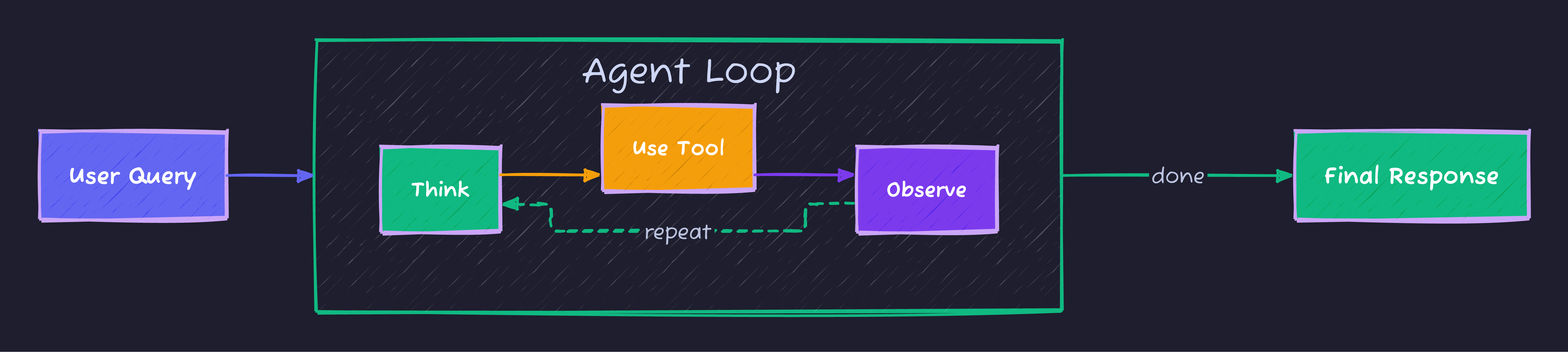
The agent iterates between thinking and tool execution until it has gathered enough information to provide a final response.
Error Handling Patterns
Retry Logic
from langchain_core.tools import tool
import time

@tool
def robust_api_call(endpoint: str, max_retries: int = 3) -> str:
    """Make an API call with automatic retries.

    Args:
        endpoint: API endpoint URL
        max_retries: Maximum retry attempts

    Returns:
        API response or error details
    """
    for attempt in range(max_retries):
        try:
            response = requests.get(endpoint, timeout=10)
            response.raise_for_status()
            return response.text

        except requests.exceptions.Timeout:
            if attempt < max_retries - 1:
                time.sleep(2 ** attempt)  # Exponential backoff
                continue
            return "Error: Request timed out after all retries"

        except requests.exceptions.HTTPError as e:
            return f"HTTP Error: {e.response.status_code}"

        except Exception as e:
            return f"Error: {str(e)}"
Validation Wrapper
def validated_tool(func):
    """Decorator to add input validation to tools."""
    @functools.wraps(func)
    def wrapper(*args, **kwargs):
        try:
            return func(*args, **kwargs)
        except TypeError as e:
            return f"Invalid arguments: {str(e)}"
        except Exception as e:
            return f"Tool error: {str(e)}"
    return wrapper
Summary
| Tool Type | Best For | Key Consideration |
|---|---|---|
| Web Search | Current information | Use specialized APIs (Tavily) |
| Code Execution | Calculations, data | Sandbox for security |
| File Operations | Document processing | Validate paths, limit size |
| External APIs | Real-time data | Handle errors, cache results |
What’s Next?
In Part 5, we’ll build multi-agent systems—teams of specialized agents that collaborate to solve complex problems.
Continue to Part 5: Multi-Agent Systems →
Full Code Repository
git clone https://github.com/Moshiour027/ai-agents-mastery.git
cd ai-agents-mastery/04-tools
pip install -r requirements.txt
python tool_agent.py
Advertisement
Moshiour Rahman
Software Architect & AI Engineer
Enterprise software architect with deep expertise in financial systems, distributed architecture, and AI-powered applications. Building large-scale systems at Fortune 500 companies. Specializing in LLM orchestration, multi-agent systems, and cloud-native solutions. I share battle-tested patterns from real enterprise projects.
Related Articles
AI Agents Fundamentals: Build Your First Agent from Scratch
Master AI agents from the ground up. Learn the agent loop, build a working agent in pure Python, and understand the foundations that power LangGraph and CrewAI.
PythonMulti-Agent Systems: Build AI Teams with CrewAI & LangGraph
Master multi-agent orchestration with CrewAI and LangGraph. Build specialized AI teams that collaborate, delegate tasks, and solve complex problems together.
PythonLangGraph Deep Dive: Build AI Agents as State Machines
Master LangGraph for building production AI agents. Learn state graphs, conditional routing, cycles, and persistence patterns with hands-on examples.
Comments
Comments are powered by GitHub Discussions.
Configure Giscus at giscus.app to enable comments.